Are giant pandas still endangered?
No. Giant pandas are not classed as Endangered. The IUCN Red List moved them to Vulnerable in 2016, and that assessment was still the current one when this page was checked on 20 November 2026. China made the same change on its national list in 2021. Vulnerable is still a threatened category, so "no longer endangered" does not mean "safe". The red panda, often confused with it, is still Endangered.
The counts are not the same number
Headlines tend to quote one figure. The sources are counting different things. This table uses only the figures those sources print. Sources checked 20 November 2026.
| What was counted | Figure | Where it comes from |
|---|---|---|
| Mature individuals | 500 to 1,000 | IUCN Red List, assessed 11 April 2016, still the current assessment. Trend: increasing. Category: Vulnerable, criteria C2a(i) and D1. |
| Wild pandas in the fourth national survey | 1,864 | China's survey for 2011 to 2014, the baseline the 2016 IUCN assessment used. |
| Wild total | Nearly 1,900 | 2025 data from the National Forestry and Grassland Administration, reported by Xinhua on 14 June 2026. The 3 November 2026 report did not replace this wild total. |
| In captivity in China, end of 2025 | 808 | Wu Honglin, deputy director at the China Conservation and Research Center for the Giant Panda, quoted by Xinhua on 14 June 2026. |
| In captivity in China | 830 | Li Yunqing, deputy head of the National Forestry and Grassland Administration, at the Global Panda Partners 2026 conference in Chengdu. Xinhua, 3 November 2026. |
One reason the IUCN figure is smaller is the thing being counted. Criterion D1 on the Red List applies when there are fewer than 1,000 mature individuals. Mature animals are not the same as every wild panda, cubs included, which is why 500 to 1,000 and nearly 1,900 can both be in print. This page does not add the captive and wild totals together, and it does not add the 830 in China to pandas living overseas.
On that overseas point, Li also said China has worked with 26 institutions in 20 countries, with 69 giant pandas living overseas and 73 cubs bred through that cooperation. The 69 are a separate statement from the 830 inside China. The 73 is a breeding total across the cooperation, not a second census. Our page on how scientists count wild pandas explains why a national survey and a Red List assessment answer different questions. The giant panda guide keeps the basic biology next to these status numbers.
What changed, and when
- 1980s: the wild population was estimated at about 1,100 (Xinhua, 14 June 2026, citing the national administration's 2025 data).
- 2011 to 2014: China's fourth national survey counted 1,864 wild giant pandas.
- 2016: the IUCN moved the species from Endangered to Vulnerable. The assessment names an increasing trend.
- July 2021: China's Ministry of Ecology and Environment reclassified the giant panda from endangered to vulnerable on the national list. That was China's own list, separate from the IUCN. The BBC reported the announcement.
- 2021: the Giant Panda National Park was established, merging 73 reserves across Sichuan, Shaanxi and Gansu.
- End of 2025: 808 giant pandas in captivity in China.
- 3 November 2026: 830 giant pandas in captivity in China.
What "Vulnerable" means
The IUCN Red List places species into categories based on extinction risk: Least Concern, Near Threatened, Vulnerable, Endangered, Critically Endangered, then Extinct in the Wild and Extinct. Vulnerable, Endangered and Critically Endangered are all "threatened". Moving from Endangered to Vulnerable means the evidence in that assessment showed a lower, but still high, risk. It records decades of protection working. It is not a retirement notice.
The 2016 assessment is old. No newer global assessment had replaced it on the Red List page on 20 November 2026. Treat the category as the current label, and treat the mature individual range as a 2016 figure, not as a 2026 recount.
Why the status improved
- Protected habitat. China began creating panda reserves in the 1960s. Xinhua reported on 14 June 2026 that the Giant Panda National Park covers about 22,000 square kilometres, and that about 72 percent of wild pandas are under strict protection. A 23 November 2025 Xinhua report, quoting Liu Guohong of the national administration, said the park protects about 1,340 wild pandas. That park total and the national wild total of nearly 1,900 are different counts. The park is the main protected block, not a list of every wild panda. See panda habitat and is giant panda habitat shrinking?
- More forest under protection. The same 14 June 2026 report said protected panda habitat grew from 1.39 million hectares to 2.58 million hectares.
- Less poaching. WWF notes poaching declined after China's 1988 Wildlife Protection Law introduced severe penalties. Pandas can still be caught in snares set for other animals.
- Connections. The park connects habitat for 13 local populations. Xinhua (14 June 2026) said six ecological corridors have been built so pandas can move. On 3 November 2026 Li said those corridors have helped the 13 local populations reconnect as one metapopulation, with more than 150 sightings of pandas and other species recorded in corridor areas.
- A captive safety net. The captive population in China went from 808 at the end of 2025 to 830 by 3 November 2026. Since 2003 the China Conservation and Research Center for the Giant Panda has released 11 captive bred pandas to the wild, of which nine had survived at the time of the 14 June 2026 report.
Read next
Why some scientists still worry
The downgrade did not retire the risks. The concerns are about what happens next, not about denying the count:
- Fragmentation. Xinhua reported on 23 November 2025 that the wild population is divided into 33 isolated groups. Small groups are more exposed to inbreeding, disease and chance events. Roads, railways and dams still cut habitat.
- Bamboo die offs. Bamboos flower and die together every few decades. A 2019 study warned that the next widespread flowering poses a major risk, especially to isolated populations. Pandas depend on bamboo almost completely (see how much bamboo a panda eats).
- Climate. Studies project that some key bamboo species, for example in the Qinling Mountains, could decline substantially this century.
- Slow recovery. A wild female raises at most one cub every two years and lives only about 15 to 20 years, so losses take a long time to replace (see how long do pandas live?).
And the red panda?
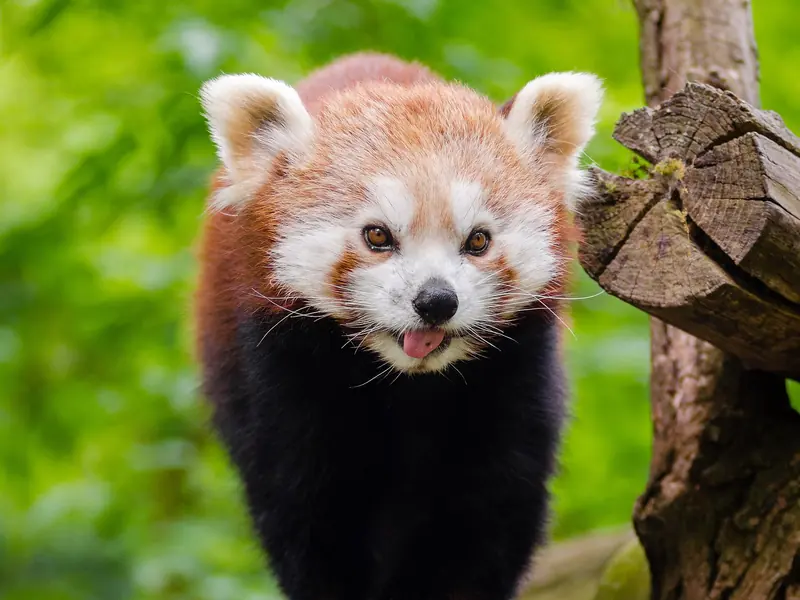
The red panda is listed as Endangered by the IUCN, with fewer than 10,000 estimated in the wild in its 2015 assessment, and the trend is downward. It faces habitat loss, traps, poaching, the illegal pet trade and disease from domestic dogs. If someone says "pandas are not endangered any more", that is true only for the giant panda, and only in the IUCN and Chinese national sense of the word Endangered. See red panda conservation.
Bottom line
The giant panda is a real conservation success: the wild total is far above the 1980s estimate, more habitat is protected, and the label improved from Endangered to Vulnerable. It is still a threatened species. The useful question is no longer "endangered, yes or no". It is which count you mean, and whether the forests those animals use stay connected. Zoo animals outside China are a different list again: where to see pandas checks each zoo against its own page.
Frequently asked questions
When were giant pandas taken off the endangered list?
The IUCN moved the giant panda from Endangered to Vulnerable in 2016. China changed its own national classification from endangered to vulnerable in July 2021.
Is Vulnerable better than Endangered?
Yes, it is one step lower on the IUCN scale, but it is still a threatened category meaning a high risk of extinction in the wild.
How many giant pandas are there now?
Xinhua reported nearly 1,900 wild giant pandas from China's 2025 data (14 June 2026). On 3 November 2026 Xinhua reported 830 in captivity in China. The IUCN 2016 assessment, still current when checked on 20 November 2026, lists 500 to 1,000 mature individuals.
Are red pandas endangered?
Yes. Red pandas are listed as Endangered by the IUCN and their numbers are still falling.
Related guides


Sources
- IUCN Red List: Giant panda, Ailuropoda melanoleuca (Vulnerable, assessed 2016)
- BBC News (2021): Giant pandas no longer endangered but still vulnerable, says China
- Xinhua (14 June 2026): China's systematic push powers panda protection
- Xinhua (3 November 2026): Captive population of giant pandas in China reaches 830
- Xinhua (23 November 2025): National park boosts panda population
- Smithsonian's National Zoo and Conservation Biology Institute: Giant panda
- WWF: Giant panda
- Tian et al. (2019), The next widespread bamboo flowering poses a massive risk to the giant panda, Biological Conservation (PDF, Michigan State University)
- IUCN Red List: Red panda, Ailurus fulgens (2015 assessment)
Cite this page
APA
PandasWise. (2026, October 8). Are giant pandas still endangered? https://pandaswise.com/blog/are-giant-pandas-still-endangered.html
MLA
"Are giant pandas still endangered?" PandasWise, 8 Oct. 2026, https://pandaswise.com/blog/are-giant-pandas-still-endangered.html.
Chicago
PandasWise. "Are giant pandas still endangered?" PandasWise. October 8, 2026. https://pandaswise.com/blog/are-giant-pandas-still-endangered.html.